How to read your resume aura score
A big number, a band name, a curve and four bars. Here is what each one is telling you — and which one to fix first.
Your aura score is a 0–100 grade for how convincingly your resume sells your work. It is built from four things the app measures separately — action verbs, quantified impact, clarity and completeness — and then placed on a curve against every other resume that has been scored. A score in the 50s does not mean your career is weak. It usually means your writing is under-selling it.
Below is a real score screen from the demo resume the app ships with — Alex Morgan, a product leader with a genuinely strong background — scoring 58. Let's take it apart piece by piece.
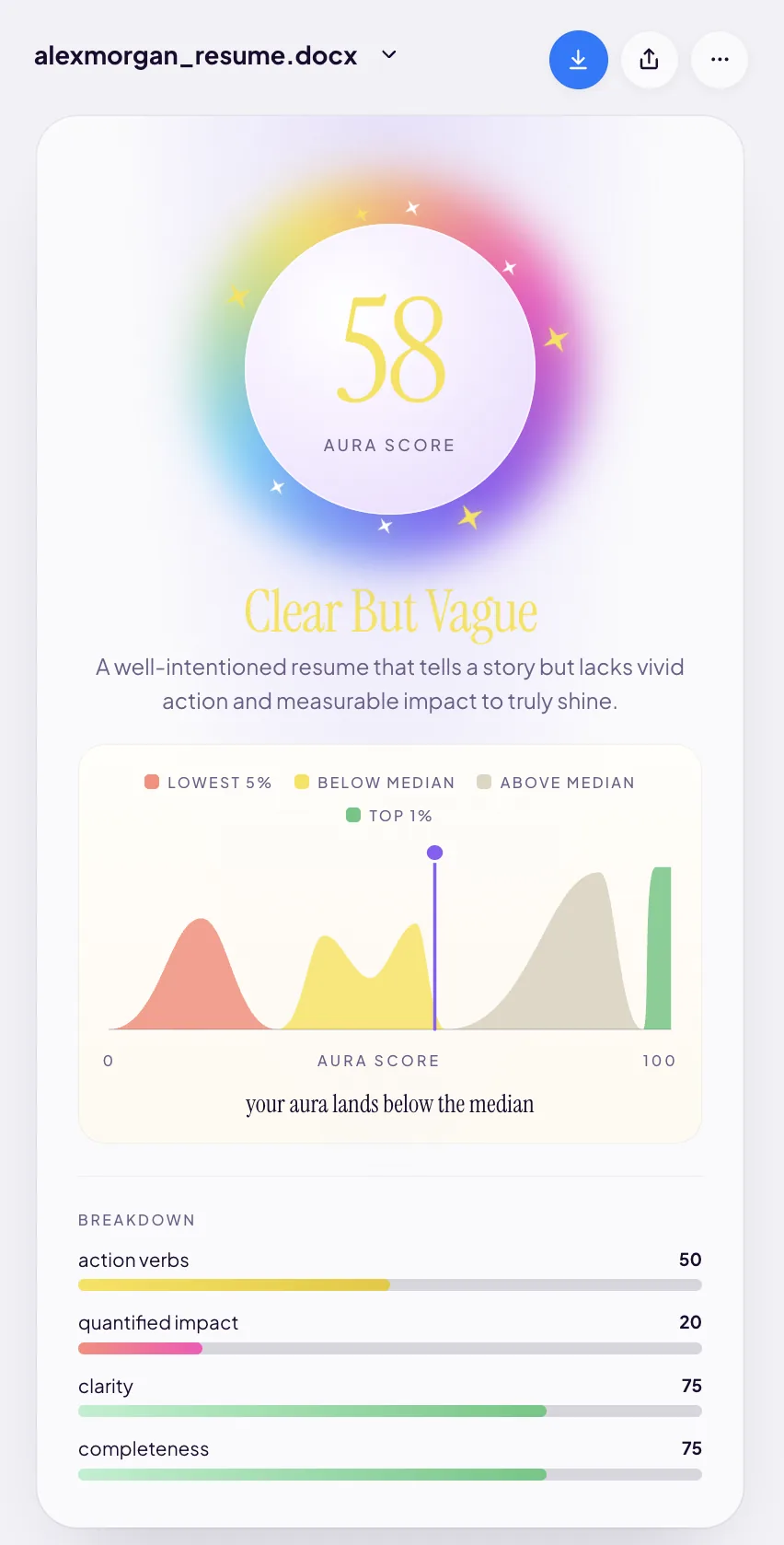
1. The number: 58 out of 100
The headline number is a weighted roll-up of the four breakdown dimensions. It is deliberately not a pass/fail. A 58 is the classic "good career, flat writing" result: nothing is broken, nothing is missing, but nothing lands with force either. The fastest way to move it is almost never to rewrite your whole history — it's to fix the specific lines the app flags.
What the number is not is a prediction of whether you'll get the job. It measures the document, not you. Two people with identical experience can score 40 points apart purely on how they wrote their bullets.
2. The band name: "Clear But Vague"
Under the number you get a short, human verdict — here, Clear But Vague, with the line "A well-intentioned resume that tells a story but lacks vivid action and measurable impact to truly shine."
The band name is the single most useful sentence on the screen, because it names the failure mode. "Clear But Vague" means a recruiter can follow your resume without effort (clarity is fine) but finishes it without a single hard fact to repeat to a hiring manager. That is a very different problem from a resume that's dense, jargon-heavy and hard to parse — and it needs a different fix.
3. The curve: where you land against everyone else
The chart is a distribution of every aura score ever computed, split into four bands: lowest 5% below median above median top 1%. The vertical marker is you. In the screenshot above, the caption says it plainly: "your aura lands below the median."
This is the part people find most uncomfortable, and it's the part that matters most. A 58 in isolation sounds like a C+. A 58 below the median of everyone applying means that when a recruiter puts your resume next to the stack, yours is on the weaker half — with the same experience.
The curve is drawn from an anonymous aggregate. Every scan contributes exactly one integer and a timestamp — no resume text, no filename, no IP, nothing that could be traced back to you. Your resume file itself is read once to compute the score and then discarded; it is never stored. (The full detail is in the privacy policy.)
4. The breakdown: the four bars are your to-do list
This is where the score becomes actionable. Alex Morgan's four bars:
- action verbs — 50. Half the bullets open with a limp verb: Oversaw, Contributed to, Directed. These describe presence, not achievement.
- quantified impact — 20. The lowest bar by a mile, and the one dragging the score down. Almost nothing on the page carries a number.
- clarity — 75. Healthy. The sentences are readable and the structure is conventional.
- completeness — 75. Healthy. Summary, experience, education and skills are all present with dates and locations.
Read as a set, those four bars tell a very specific story: the resume is well-built and badly sold. Clarity and completeness are the plumbing — they're fine. Action verbs and quantified impact are the persuasion — they're failing.
Fix the lowest bar first
Quantified impact at 20 is the highest-leverage number on the screen. A resume with no metrics forces the reader to take every claim on faith, and recruiters don't. "Improved customer satisfaction" is an assertion. "Improved customer satisfaction scores by 15%" is evidence. Same work, completely different document.
Action verbs at 50 is the second lever, and it's the cheapest fix on the entire page — it's a one-word change per bullet. Oversaw → Led. Contributed to → Drove. Helped with → Built. We break this down bullet by bullet in how to fix a weak resume bullet.
See your own aura score
Upload a PDF or DOCX and get the number, the band, the curve and the four bars in under a minute.
Get my free resume score →Free score, free fixes. No sign-up.
From the score screen to the fix
The score screen is a diagnosis, not a treatment. The treatment lives one tap away: switching to the resume view shows every flagged line highlighted in place, and the issues tab counts them — for Alex Morgan, 11 issues, grouped into four named types (weak action verb, vague / buzzword, bullet length, missing metrics).
Those names map directly back onto the bars you just read. Weak action verb and vague / buzzword issues are what dragged action verbs to 50. Missing metrics issues are what dragged quantified impact to 20. The breakdown tells you what is weak; the issues list tells you which lines, so you never have to guess where to start. That taxonomy is worth understanding on its own — see the four issue types, explained.
What a good score actually looks like
People ask for a target number. The honest answer is that the band matters more than the digit: get out of below median and into above median, and you have a resume that reads as competitive rather than as one of the pile. In practice that means:
- Every bullet opens with a real verb. Not "responsible for", not "helped", not "worked on".
- At least half your bullets carry a number. Percentages, dollars, headcount, time saved, volume shipped. Estimates are fine if they're honest.
- No bullet needs a second read. One idea per line.
- Nothing obvious is missing. Dates, locations, a summary that says what you do rather than that you're passionate about doing it.
Hit those four and the bars move together — which is the whole point of scoring them separately.
Re-scan and watch it move
The score is not a one-shot verdict. Apply fixes in the editor, re-scan, and you get a new number and a new position on the curve. That loop — score, fix, re-score — is the entire product, and it costs nothing: the analysis, the suggestions and every rewrite are free, with no account. The only thing you ever pay for is the polished download, and only if you want it.
If you'd rather see the whole loop end to end before you upload anything, read the full walkthrough, or watch a 58 get taken apart line by line in the case study.
Ready when you are
Your resume is read once to compute the score, then discarded. Nothing is stored.
Score my resume free →