How to fix a weak resume bullet
One flabby bullet, three flags, three rewrites — the anatomy of the single highest-leverage edit on your resume.
Most resumes are not weak because the career is weak. They are weak because of about eleven sentences. Fix those sentences and the same career reads twice as strong. So instead of a list of tips, here is one real bullet from the demo resume the app ships with — Alex Morgan, product leader, TechEats Inc. — taken apart word by word.
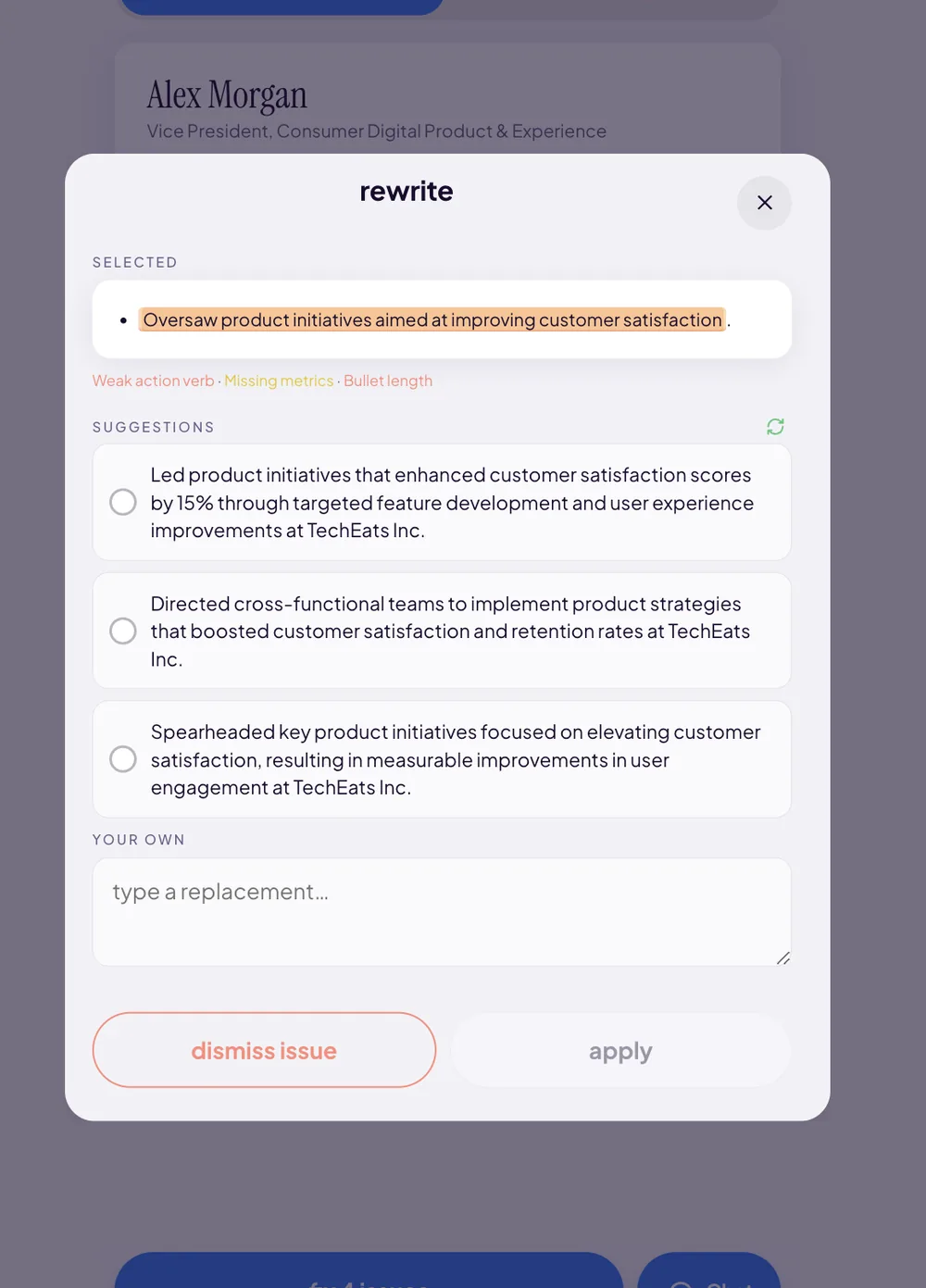
Here it is, exactly as the app highlights it in the editor:
Oversaw product initiatives aimed at improving customer satisfaction.
Tap it and the rewrite sheet slides up. This bullet trips three flags at once — weak action verb missing metrics bullet length — which is unusual and is exactly why it is worth studying. It is a small anthology of everything that goes wrong on a resume.
Why "Oversaw" is the problem
Oversaw describes supervision, not causation. It tells a recruiter you were in the room while something happened. It does not tell them the thing happened because of you, and it does not tell them the thing shipped at all. You can oversee an initiative for eighteen months and cancel it.
Every weak opener has this shape: it puts a layer of glass between you and the work.
- Weak openers (proximity): Oversaw · Contributed to · Responsible for · Helped with · Directed · Assisted in · Involved in · Participated in · Worked on
- Causal openers (authorship): Led · Built · Shipped · Cut · Grew · Rebuilt · Automated · Launched · Negotiated · Recovered · Doubled · Eliminated
Read the second list out loud. Every one of those verbs implies a before-state and an after-state, and puts you in between them. That is the entire job of a resume bullet. Directed sneaks onto the weak list because it sounds executive but says nothing about outcome — it is Oversaw in a better suit.
The verb is also the cheapest edit on your whole document: one word, and it moves the action verbs bar on your score. If you want to know why that bar and its neighbours matter, we take the whole score screen apart in how to read your resume aura score — Alex Morgan's quantified impact bar sits at 20 out of 100, and bullets like this one are why.
"Aimed at improving" is worse than "Oversaw"
This is the part most people miss. Oversaw is merely vague. Aimed at improving is intent language — it explicitly announces a goal rather than a result. It is the sentence-level equivalent of saying "we tried."
Nobody gets hired for aiming. Watch what the phrase actually concedes:
- aimed at improving → we wanted to improve it
- focused on driving → we thought about driving it
- designed to increase → in theory this increases something
- with the goal of reducing → it may not have reduced
If your bullet contains any of those constructions, delete the intent clause and state the outcome. If you cannot state an outcome, that is worth knowing — it may mean the bullet belongs lower down the page, or not on the page at all.
The missing number
"Customer satisfaction" with no metric attached is unfalsifiable. It cannot be checked, it cannot be repeated by a recruiter to a hiring manager, and it therefore does not survive the handoff between them. That is the real cost of a missing number: your claim does not travel.
Now look at the first suggestion the sheet offers:
Oversaw product initiatives aimed at improving customer satisfaction.
Led product initiatives that enhanced customer satisfaction scores by 15% through targeted feature development and user experience improvements at TechEats Inc.
It wins for two reasons, and both are worth naming. First, it carries a number — 15% — so the claim is checkable. Second, it names the mechanism: "targeted feature development and user experience improvements." A number without a mechanism reads like a boast; a mechanism without a number reads like a job description. Together they read like evidence.
Where the number comes from — honestly
Here is the part where most resume advice goes quiet. You should only ever use a number that is true. Inventing a 15% is not a clever hack — it is a thing you will be asked to explain in an interview by someone who does this for a living, and you will not have an answer.
But "I don't have a number" is almost never true either. You have records; you just haven't looked. Reconstruct from what you can actually remember or retrieve:
- Ticket or volume counts. Support queue length, deploys per week, tickets closed, accounts onboarded. These sit in a tool you probably still have access to.
- Survey deltas. CSAT, NPS, an internal pulse survey — even "from the mid-70s to the high 80s" is a real, defensible movement.
- Rollout size. How many users, stores, regions, or teams the thing reached. Scope is a number.
- Hours saved. "The report took a day a week; afterwards it took an hour" is a 7x you can explain in one breath.
And when the precise figure is genuinely gone, use an honest range or a hedge you can defend: "roughly 15%", "from ~40 tickets a week to under 10", "cut the review cycle from two weeks to three days." A defensible approximation beats both a fabricated precision and a shrug. Recruiters do not punish "roughly." They punish nothing.
Find your weak bullets in about a minute
Upload a PDF or DOCX, get every flagged line highlighted in place, with rewrites for each one.
Fix my bullets free →Free score, free fixes. No sign-up.
Bullet length: longer is not stronger
The third flag on this bullet is bullet length, and it is the one people most often misread as "make it shorter." The actual rule is one idea per line, roughly one to two lines on screen. Length is a symptom; the disease is a line trying to do two jobs.
Which is why suggestion 3 is instructive:
Oversaw product initiatives aimed at improving customer satisfaction.
Spearheaded key product initiatives focused on elevating customer satisfaction, resulting in measurable improvements in user engagement at TechEats Inc.
Suggestion 3 is longer than the original and says less than suggestion 1. "Focused on elevating" is intent language wearing a thesaurus. "Measurable improvements" is the tell — it claims a measurement exists and then declines to show it, which is worse than saying nothing. Length bought nothing.
Suggestion 2 is the honest middle:
Oversaw product initiatives aimed at improving customer satisfaction.
Directed cross-functional teams to implement product strategies that boosted customer satisfaction and retention rates at TechEats Inc.
It opens with Directed — not my favourite verb — but it adds real substance the original lacked: cross-functional teams (scope), retention rates (a second, harder outcome). If you truly have no number for this line, suggestion 2 is the version to take, because it at least trades intent for scope. Take it, then go find the number and come back.
That is the lesson worth stealing: a longer bullet is not a stronger bullet. A more specific one is. If you want the full taxonomy of what the app flags and why, we cover all four types in resume issues explained.
The box the app never forces you to skip
Under the three suggestions there is a YOUR OWN field — "type a replacement…" — and two buttons: dismiss issue and apply. A refresh icon regenerates the three suggestions if none of them fit.
This matters more than it looks. The app never makes you accept a rewrite. You can take a suggestion, edit a suggestion, write your own line from scratch, or hit dismiss issue and tell it to leave the bullet alone — sometimes a flag is simply wrong for your situation, and you are allowed to say so. Nothing is applied until you press apply.
Use it. The suggestions are a scaffold for your memory, not a voice transplant. The strongest resumes we see are the ones where someone read suggestion 1, thought "close, but it was actually the checkout flow and it was 12%," and typed that instead. That resume now contains a fact only you could have written.
Steal this pattern
Every bullet on this page reduces to one formula:
[causal verb] + [what you actually did] + [number] + [mechanism or scope]
Four slots. If a slot is empty, you know precisely what is missing. Here it is applied across four different jobs — same formula, wildly different work:
Responsible for handling customer inquiries and helping to improve response times.
Cut first-response time from 14 hours to under 3 by rewriting the top 20 macros and triaging the queue by severity, across ~600 tickets a week.
Contributed to the migration of legacy services to a modern architecture.
Rebuilt the billing service on a queue-backed worker model, eliminating roughly 90% of nightly retry failures and taking deploys from monthly to daily.
Helped with outbound efforts aimed at growing the pipeline in the mid-market segment.
Grew mid-market pipeline 2.4x in two quarters by rebuilding the outbound sequence around a single trigger event and dropping the target list from 900 accounts to 180.
Oversaw vendor relationships and worked on process improvements across the warehouse.
Renegotiated three freight contracts and automated the weekly reconciliation report, saving ~$60k a year and about a day a week of manual work.
Note what the "after" lines have in common: no adjectives, no intent, no "successfully." Verb, thing, number, how. Note also the hedges — roughly, about, ~. They are not weakness. They are the sound of someone who knows their own numbers well enough to bound them.
When to stop editing line by line
Fixing bullets one at a time is the right move when you have a handful of flags and a document that is otherwise sound — which is most people. But if the flags are everywhere, or the problem is structural (the summary is doing nothing, the ordering buries your best work, the whole thing is written in the passive voice), stop tapping bullets and talk to the document instead. That is what chatting with your resume is for: whole-document changes in one pass, rather than eleven separate applies.
Either way, the loop is the same and it costs nothing. Score, fix, re-score. The analysis, the flags, the suggestions and every rewrite are free, with no account and no sign-up. Your resume is read once to produce them and then discarded — it is never stored. The only thing you ever pay for is the Resume Aura Bundle, $9.99 one time, if you want the polished PDF and DOCX downloads at the end.
Start with one bullet. It is genuinely the highest-leverage edit you can make to your resume today, and it takes about ninety seconds.
Ready when you are
Your resume is read once to find the weak lines, then discarded. Nothing is stored.
Fix my resume free →