The four resume issues we flag — and how to clear them
Every problem the app finds is sorted into one of four named types. Here's what each one means, why it quietly costs you callbacks, and exactly how to fix it.
Resume Aura doesn't hand you a wall of generic advice. It hands you a numbered list of specific lines, each tagged with one of four issue types. That's deliberate. "Make your resume stronger" is not actionable. "This bullet opens with Oversaw, which describes presence rather than achievement" is — because you can fix it in nine seconds.
Here's the issues card from the demo resume the app ships with: Alex Morgan, a product leader with a real career behind them, scoring 58 with 11 issues.
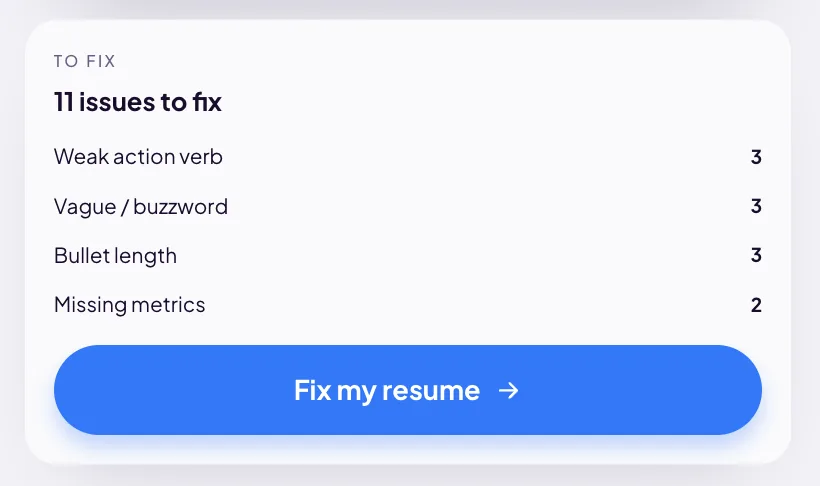
Four types. Eleven lines. No mystery. Let's take each type in turn.
1. weak action verb — 3 issues
A weak action verb puts you near the work without ever claiming you caused it. Alex's three flagged openers are the canonical set: Oversaw, Contributed to, Directed.
Every one of them is true. Every one of them is unfalsifiable. "Contributed to a redesign" is compatible with having led the redesign and with having attended two meetings about it — and a recruiter reading 200 resumes will assume the second. That's the whole cost: you wrote the modest version of the truth, and it gets read as the small version.
The fix is a one-word swap, and it's the cheapest edit on the entire page. Lead with a verb that names what you caused: Led, Drove, Built, Shipped, Launched, Cut, Grew, Rebuilt, Negotiated.
Oversaw the product roadmap for the core platform team.
Owned the core platform roadmap, shipping 4 of 5 committed releases on schedule.
Notice what changed and what didn't. The job is identical. The verb now asserts ownership, and the clause after the comma gives the reader something to hold. One flag cleared, and a missing metrics flag cleared along with it — the types overlap constantly, which is why fixing the top of the list tends to knock down more than one item.
2. vague / buzzword — 3 issues
Alex's professional summary is the perfect case study, because all three of its sentences got highlighted:
- "Experienced product leader with a track record of delivering results"
- "Skilled at managing teams and driving initiatives that impact customers and business"
- "Always eager to tackle new challenges and move quickly"
Read those three lines and ask what you now know about Alex that you didn't before. The answer is nothing. Not the product, not the team size, not the domain, not one thing that could be checked. Every sentence is constructed so that it cannot be wrong — which also means it cannot be evidence.
Buzzwords aren't forbidden words; they're wasted lines. The summary is the most valuable real estate on the resume — the first six seconds of attention — and Alex spent all of it on three claims that any candidate in the pile could have written verbatim. That's the failure: not that "track record of delivering results" is offensive, but that it's interchangeable.
The fix: replace the adjective with the artifact. Every time you catch yourself reaching for a quality, name the thing that proves it instead.
Experienced product leader with a track record of delivering results. Skilled at managing teams and driving initiatives that impact customers and business.
Product leader, 9 years across fintech and marketplace platforms. Built and ran a team of 12 through two 0→1 launches; most recent product reached $4M ARR in 18 months.
"Experienced" became 9 years. "Managing teams" became a team of 12. "Delivering results" became $4M ARR in 18 months. Same career, same person, same honesty — but now every clause is falsifiable, which is exactly what makes it believable.
3. bullet length — 3 issues
This flag fires in both directions, and people are usually surprised by that.
Too long is the common case: a bullet that runs three or four lines, stitches two accomplishments together with an and, and arrives at its point somewhere past the second comma. Recruiters skim. A bullet that needs a second read doesn't get one — it gets skipped, and the achievement buried in the middle of it is simply never seen. If a bullet contains two things you're proud of, that's two bullets.
Too short is the quieter failure: "Managed the mobile team." Six words, no evidence, no scale, no outcome. It occupies a line on your resume and pays no rent.
The target is one idea per line, roughly one to two lines on screen. Long enough to carry a claim and its proof; short enough that the eye lands on it whole. Bullet-length issues are what drag the clarity bar in your score breakdown — the dimension that measures whether a recruiter can understand each line on a single pass.
4. missing metrics — 2 issues
Only two flags, but this is the type that did the most damage to Alex's score: quantified impact came in at 20 out of 100, by far the lowest bar on the screen.
A resume without numbers asks the reader to take every claim on faith. They won't. "Improved customer satisfaction" is an assertion; "improved customer satisfaction scores by 15%" is evidence. Identical work, completely different document.
The fix is to attach a number to the claim — any honest number:
- % — conversion, retention, churn, error rate, satisfaction
- $ — revenue influenced, budget owned, cost removed
- headcount — people managed, teams coordinated, stakeholders aligned
- time — cycle time cut, launch pulled forward, hours saved per week
- volume — users, transactions, tickets, releases, markets
The objection we hear most: "I don't have exact figures." You don't need exact figures. An honest estimate you'd be comfortable defending in an interview is fine, and it's what nearly everyone with a strong resume is already doing. "Roughly 30% faster" beats silence, and "supported a team of about 15" beats "supported the team." What you must not do is invent something you can't stand behind in the room.
See your own four numbers
Upload a PDF or DOCX and get every flagged line, sorted by type, in under a minute.
Find my resume issues free →Free score, free fixes. No sign-up.
How the four types map onto your score
The issue types aren't a separate system from the score — they're the same finding, viewed from the other end. Each flagged line pushes down a specific breakdown bar:
- weak action verb + vague / buzzword → action verbs 50. Six of Alex's eleven issues live here. Half the bullets open with a verb that concedes ownership, and the summary spends three sentences saying nothing checkable.
- missing metrics → quantified impact 20. The lowest bar on the page, and the highest-leverage thing to fix.
- bullet length → clarity. Lines that need a second read, or that carry no payload at all.
Which is why the two screens are worth reading together: the breakdown tells you what is weak, the issues list tells you which lines. You never have to guess where to start.
Reading the editor: green means keep, orange means look
Switch to the resume view and the flags stop being a list and become a map. Every line is highlighted in place.
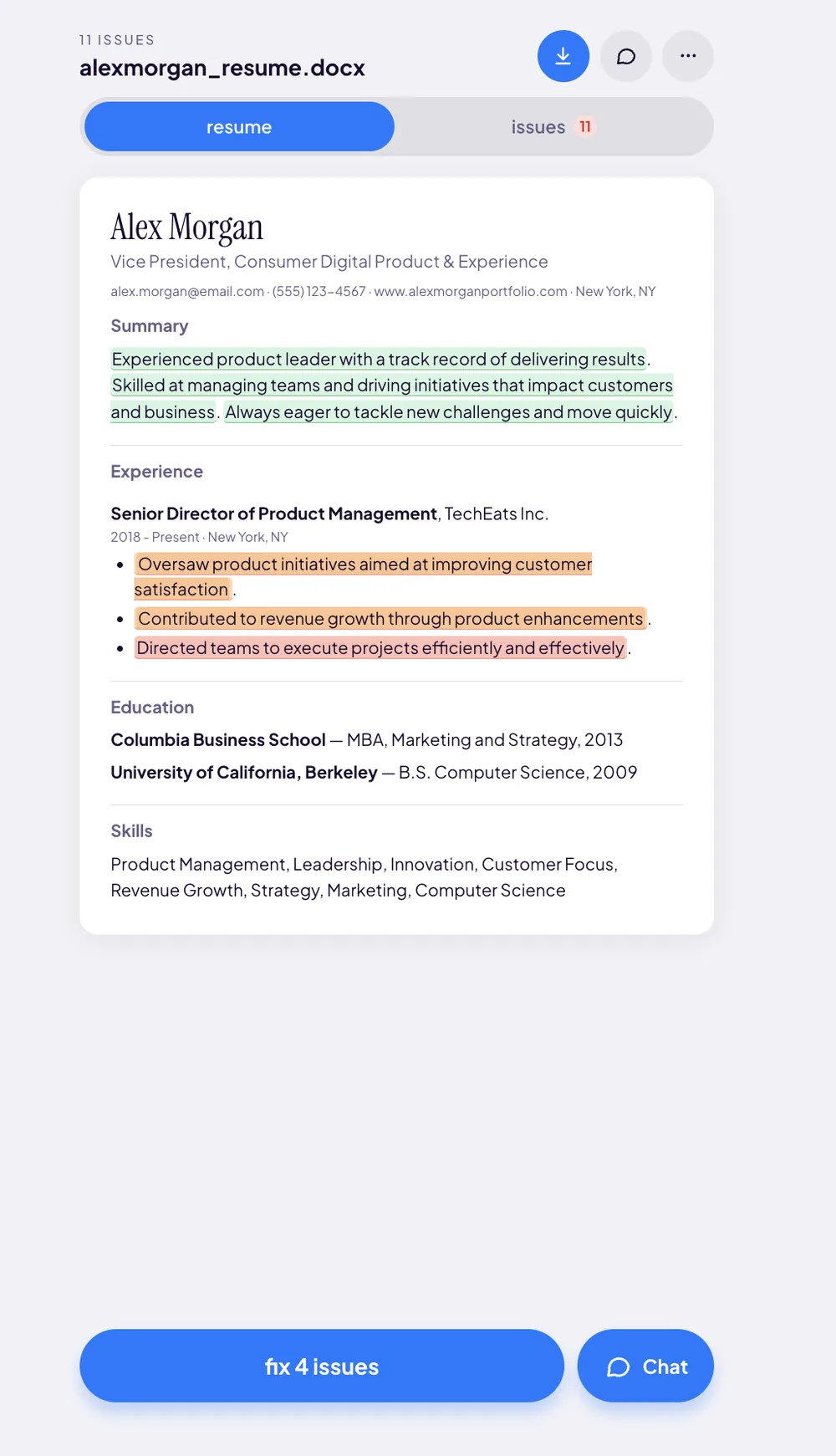
The colour language is simple:
- Green highlight — this line reads strong. Leave it alone.
- Orange / red highlight — this line is flagged. Tap it and you get the issue type and a suggested rewrite.
Across the top, two tabs: resume and issues 11. At the bottom, a fix 4 issues button that applies the rewrites you've selected in one pass, and a Chat button if you'd rather argue with the suggestion than accept it. The rewrite mechanics — how a suggestion is built and how to make it sound like you rather than like a template — are covered line by line in how to fix a weak resume bullet.
The issues card is a to-do list, not a verdict
Work it top-down. The list is ordered so the highest-leverage lines sit at the top, and because the types overlap — a weak verb and a missing metric are usually the same bullet — clearing the first few items tends to knock down more than you expect. Alex's eleven issues are not eleven separate rewrites; they're closer to six.
And you are not obliged to accept any of it. Dismissing an issue is a legitimate move. Sometimes a short bullet is short on purpose. Sometimes the "buzzword" is a genuine term of art in your field and the hiring manager is scanning for exactly that string. Sometimes you simply don't have a number and you're not going to fabricate one — good, don't. The app flags patterns; you know your career. The button says fix, not must fix, and every dismissal is one click.
What you shouldn't do is dismiss an issue because the rewrite makes you uncomfortable in the way that accurate is uncomfortable. Most people under-sell their own work by reflex — that's the whole reason a resume like Alex's, with a genuinely strong career behind it, lands at 58.
Then re-scan
Clear the flags, re-run the scan, and watch the bars move. Action verbs and quantified impact respond fastest, because they're the two dimensions most directly tied to individual lines. That loop — scan, fix, re-scan — is the entire product, and it costs nothing: the score, the flagged issues, every suggestion and every rewrite are free, with no account. The only paid item is the Resume Aura Bundle, $9.99 one time, if you want the polished PDF and DOCX downloads at the end. Your resume file is read once to run the analysis and then discarded — it is never stored.
If you want to see the whole thing end to end before uploading anything, the full walkthrough runs the demo resume from upload to download.
Find out which lines are costing you
Eleven issues took Alex Morgan from a strong career to a 58. Find yours in under a minute.
Check my resume free →