A 58 aura, taken apart line by line
The same career, the same jobs, the same eleven bullets — rewritten. A full before-and-after teardown of a resume that was under-selling a genuinely strong product leader.
Meet Alex Morgan. Vice President, Consumer Digital Product & Experience, New York. Senior Director of Product Management at TechEats Inc. since 2018. An MBA in Marketing and Strategy from Columbia Business School, and a B.S. in Computer Science from Berkeley before that. On paper: technical foundation, business school, a real title at a real company, no gaps.
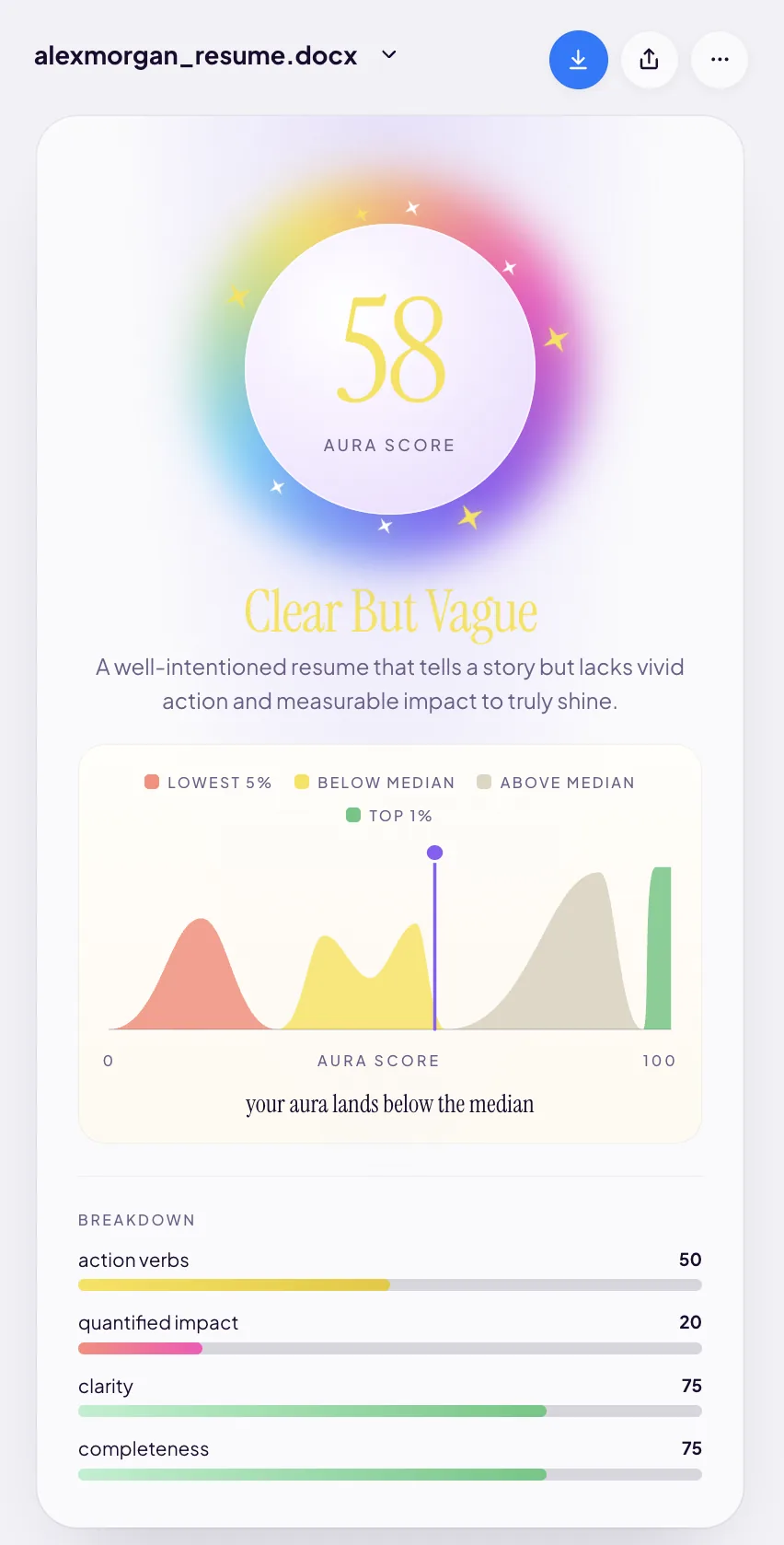
Alex Morgan's resume scores 58, and lands below the median.
That gap — between the career and the document describing it — is the subject of this article. Nothing is missing from this resume. Nothing about it is confusing. It simply never makes a claim a recruiter can verify, remember, or repeat to a hiring manager. Here is the teardown.
The diagnosis
The band name does most of the work: Clear But Vague — "A well-intentioned resume that tells a story but lacks vivid action and measurable impact to truly shine." That is not a polite way of saying "bad resume." It names a specific failure, and the four bars confirm it:
- action verbs — 50. Half the bullets open with something limp.
- quantified impact — 20. Almost nothing on the page carries a number.
- clarity — 75. Fine. Readable, conventional, no jargon soup.
- completeness — 75. Fine. Summary, experience, education, skills, dates, location — all present.
Quantified impact at 20 is the worst number on the page. Clarity and completeness are hygiene — a recruiter notices them only when they fail. Quantified impact is persuasion: the difference between a document that asserts and a document that proves. Scoring 20 there means asking the reader to take every claim on faith, and in a stack of two hundred, nobody does. (If the score screen is new to you, start with how to read your aura score.)
So we know the shape of the fix before reading a line. We are not adding sections or restructuring anything. We are making the existing lines say something.
The summary, sentence by sentence
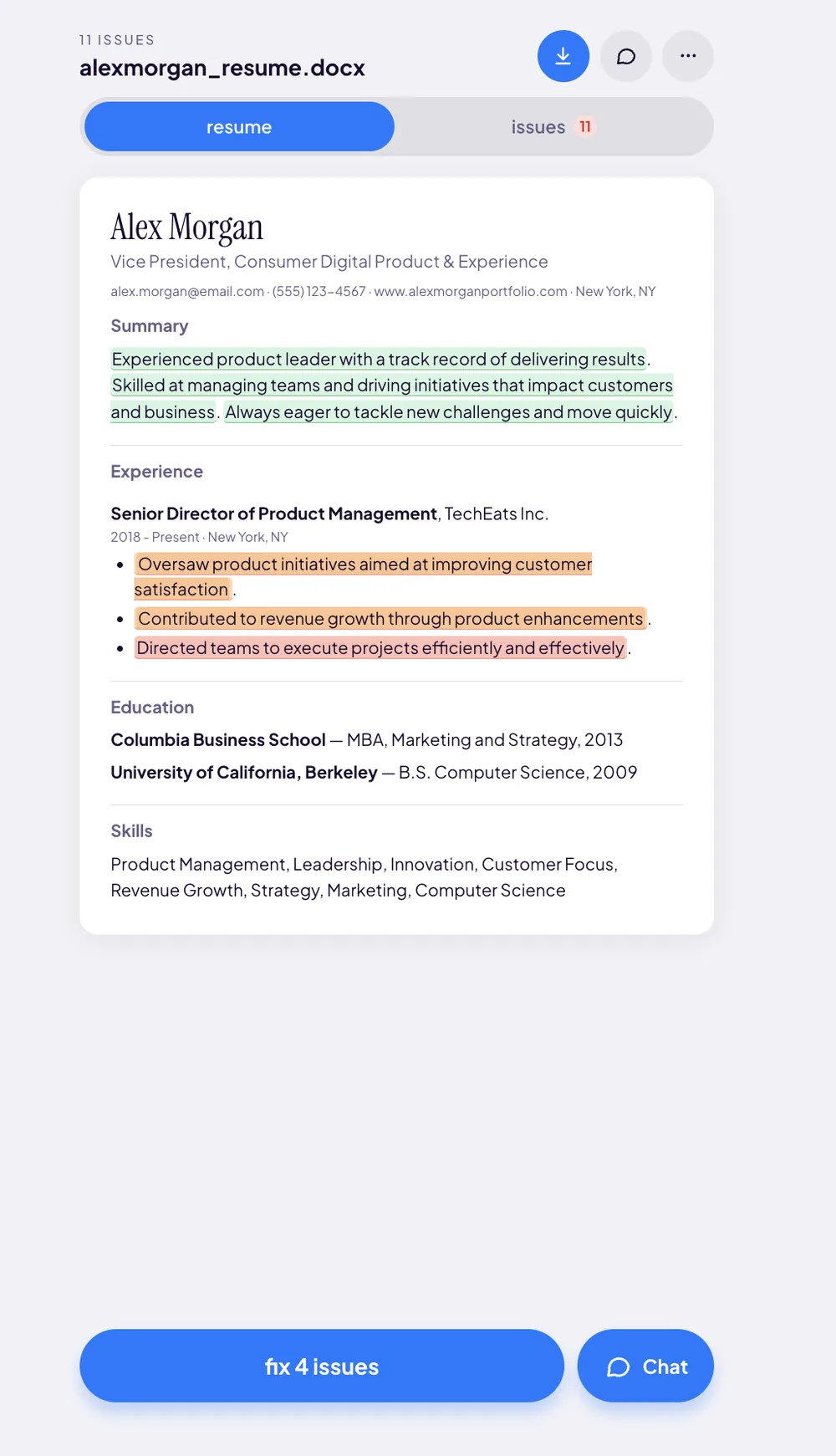
Open the editor and the summary lights up — all three sentences flagged vague / buzzword. Read it once and it sounds fine. Read it as a recruiter, whose job is to extract facts, and it collapses.
"Experienced product leader with a track record of delivering results." Which results? A track record is, definitionally, a record of specific things. Naming none of them is not a track record; it's a claim to have one.
"Skilled at managing teams and driving initiatives that impact customers and business." Every job that has ever existed impacts customers and business. This sentence is equally true of a barista, a CFO and a nuclear engineer. A line that cannot distinguish you from anyone else on earth isn't doing work — it's occupying the most valuable real estate you own.
"Always eager to tackle new challenges and move quickly." A personality claim, not evidence. Nobody has ever written "reluctant to tackle new challenges, prefers to move slowly." Self-reported enthusiasm is unfalsifiable, and it burns the closing line on something no reader will check.
Three sentences, zero facts. Rewrite it using only what the rest of the document already tells us — consumer digital product, TechEats, a decade, teams:
Experienced product leader with a track record of delivering results. Skilled at managing teams and driving initiatives that impact customers and business. Always eager to tackle new challenges and move quickly.
Consumer product leader with a decade at TechEats Inc., where I grew ordering and personalization from a single squad to a 20-person product org. I ship customer-facing digital experiences that move retention and revenue, and I have the CS background to argue with engineering about how.
Two sentences instead of three. Same person, same career, no achievements invented. This version tells a recruiter what Alex does, at what scale, and why they'd be good at it — and every clause invites a follow-up question. That is the test. If nobody could interrogate a line, it isn't earning its place.
The bullets: three lines, eleven problems
The issues tab counts 11: weak action verb ×3, vague / buzzword ×3, bullet length ×3, missing metrics ×2. The pattern for rebuilding each one is the same: [causal verb] + [what you did] + [number] + [mechanism]. The verb says you caused it. The number makes it checkable. The mechanism makes it credible.
Bullet 1
Oversaw product initiatives aimed at improving customer satisfaction.
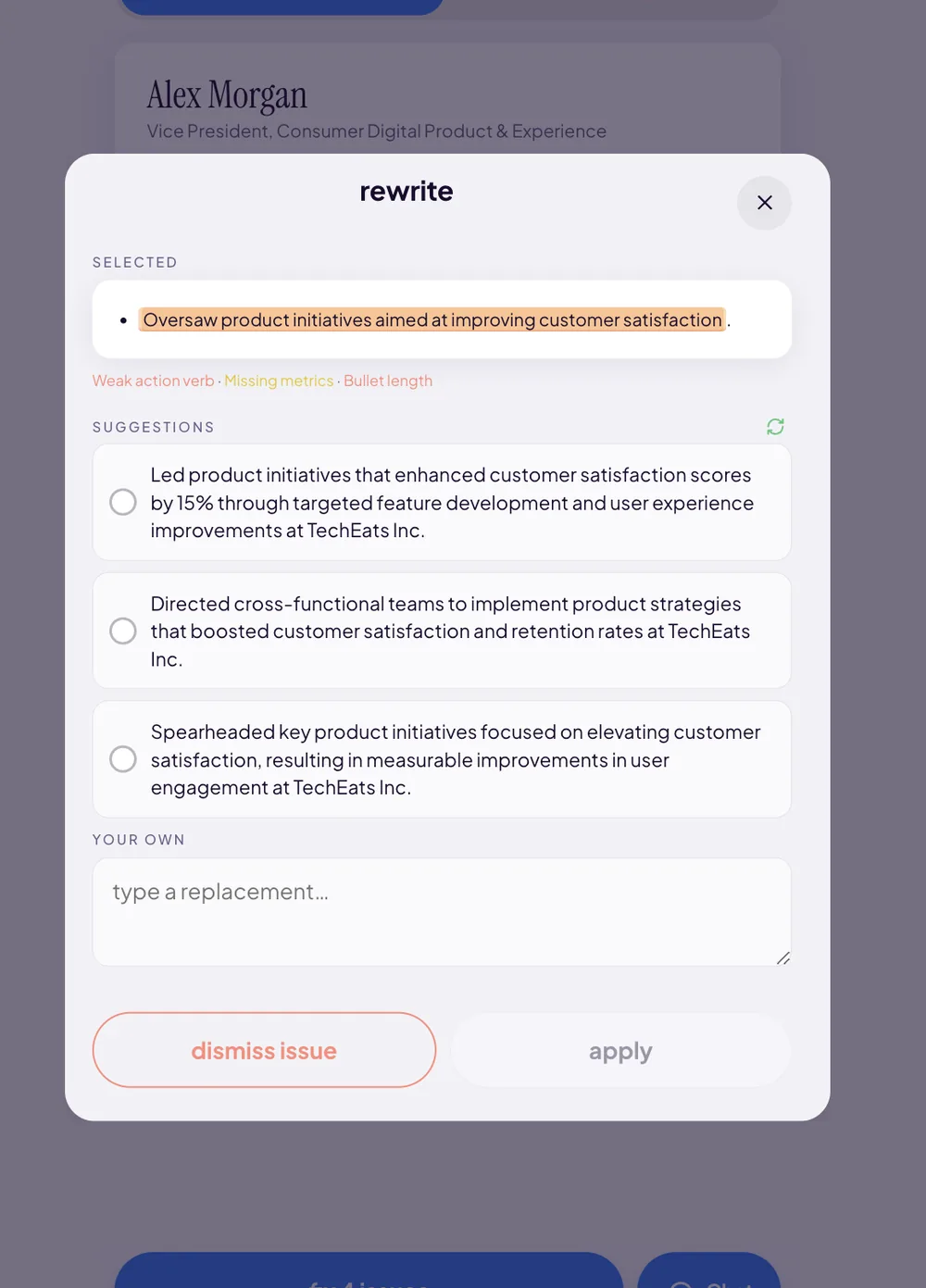
Led product initiatives that enhanced customer satisfaction scores by 15% through targeted feature development and user experience improvements at TechEats Inc.
Flags: weak action verb vague / buzzword missing metrics. Oversaw is a seating chart, not an achievement — it says Alex was in the room. Aimed at is worse: it concedes the outcome is unknown. This is a sentence whose own grammar admits it may not have worked. The rewrite swaps in a causal verb (Led), a number (15%) and a mechanism (feature development, UX improvements). Now it is a claim, and claims can be believed.
Bullet 2
Contributed to revenue growth through product enhancements.
Drove an 11% lift in repeat-order revenue by rebuilding the checkout and reorder flow, shipped to 100% of iOS and Android users over two quarters.
Flags: weak action verb vague / buzzword missing metrics. Contributed to is the most self-deprecating phrase on any resume: it means "I was adjacent to a good thing." And product enhancements could describe any change to any product ever made. The rewrite names which revenue (repeat-order), how much (11%), what was built (checkout and reorder) and the rollout scale (both platforms, two quarters). Same work, entirely different document.
Bullet 3
Directed teams to execute projects efficiently and effectively.
Grew and led a 20-person product org across four squads, moving the team from quarterly releases to a two-week ship cadence.
Flags: weak action verb vague / buzzword bullet length. "Efficiently and effectively" consumes words and delivers nothing — delete both adverbs and the sentence loses zero information, which tells you they were never carrying any. The rewrite trades them for the two numbers that actually describe leadership: headcount and cadence. Twenty people, four squads, quarterly to fortnightly. A hiring manager reads that and knows exactly what Alex can run.
None of these rewrites required a new job, a new employer or a new skill. Every "after" is built from facts that already existed in Alex's head and simply never made it onto the page. That is what a 58 usually is: a good career, badly transcribed.
What's hiding in your resume?
Upload a PDF or DOCX and get the score, the flagged lines and the rewrites in under a minute.
Get my free resume score →Free score, free fixes. No sign-up.
A word about the skills section
Alex's skills line reads: Product Management, Leadership, Innovation, Customer Focus, Revenue Growth, Strategy, Marketing, Computer Science.
Six of those eight are abstractions. "Leadership" is not a skill you can demonstrate in a comma-separated list; it is a conclusion a reader draws from your bullets. "Innovation" and "Customer Focus" are values. "Revenue Growth" is an outcome. They tell a recruiter nothing they wouldn't already assume about a VP applicant, and they burn the one section keyword search actually reads.
What belongs there is tools, platforms and domains: the analytics stack, the experimentation platform, SQL, roadmapping tooling, the verticals — consumer marketplaces, food delivery, subscription pricing, mobile growth. Searchable, checkable, non-obvious. An abstraction carries no signal precisely because nobody would ever list its opposite. Nobody writes "Innovation-Averse."
What actually moves the score
Rank the work by leverage, because they are not equal:
- 1. Metrics. Quantified impact is at 20 — the lowest bar and therefore the one with the most headroom. Every number you add moves it. This is where the first hour goes, full stop.
- 2. Verbs. Action verbs at 50 is the cheapest fix on the page: a one-word change per bullet. Oversaw → Led. Contributed to → Drove. Directed → Grew. Minutes of work, real movement. The taxonomy behind these flags is spelled out in the four issue types, explained.
- 3. Trimming. Bullet length issues are last, because a long bullet with a number in it still beats a short one without.
And note what is not on that list. Clarity is 75. Completeness is 75. Both healthy. Any effort spent reformatting the layout, adding sections or hunting for a prettier template goes into the two things that were never broken — which is the most common way people waste a weekend on their resume. Alex Morgan does not need a new template. Alex Morgan needs eleven sentences rewritten. For the mechanics of a single line, see how to fix a weak resume bullet.
The numbers have to be true
Let's be blunt: do not invent achievements. Not because an ATS will catch you — because the interview will, forty minutes in, when someone asks how you measured the 15% and you have nothing. A fabricated number is worse than no number: it converts a weak resume into a failed interview.
But "I don't have numbers" is almost always false. You have them; you just haven't gone looking. Reconstruct honestly:
- Survey deltas. Did CSAT, NPS or app-store rating move while you owned the thing? Anything with a dashboard has a before and an after.
- Ticket and volume data. Support tickets per week, orders per day, sessions, signups, tickets deflected. Ops teams track everything, and they'll tell you if you ask.
- Rollout size. "Shipped to 100% of iOS and Android users" is a number — and one you certainly know.
- Headcount. How many people, how many squads, how many hires. You know this exactly.
- Release cadence. Quarterly to fortnightly. Six-week cycles to weekly. The easiest metric to remember and one of the most persuasive.
When you genuinely cannot pin a figure, use a range and say so. "Cut checkout drop-off by roughly 10–15%" is credible, defensible and far stronger than "improved checkout." Recruiters don't expect audited financials; they expect someone who knows the scale of their own work. Rounding is fine. Estimating is fine if you can explain the estimate. Inventing is not. The rule of thumb: every number on your resume should be one you could defend for two minutes without notes.
Now re-scan
Apply the fixes in the editor and run it again. The score moves, the bars move, and the marker on the curve slides. That's the loop — score, fix, re-score, watch the number climb out of below median — and it costs nothing, as many times as you like. The analysis, the flagged issues, the suggestions and every rewrite are free, with no sign-up. Your resume is read once to produce the score, then discarded; it is never stored. The only thing you ever pay for is the Resume Aura Bundle at $9.99, one time, if you want the polished PDF and DOCX to send out.
Alex Morgan didn't need a different career. Alex Morgan needed a different draft. So, probably, do you — and it's an evening's work, not a year's. To see the whole flow before you upload anything, here's the full walkthrough.
Find your eleven issues
Your resume is read once to compute the score, then discarded. Nothing is stored.
Score my resume free →